
There is a specific moment that sells people on ambient lighting, and it almost always happens at night. You get into a car that has it, the doors close, and the cabin stops being a dark box full of grey plastic. A thin line of light traces the dashboard, follows the door card, wraps around the roofline. Nothing is brightly lit — you can still see the road perfectly well — but the interior suddenly reads as designed rather than assembled.
That effect is why ambient lighting moved from a Mercedes-only novelty in the mid-2000s to something you now find in family hatchbacks, and why the aftermarket for it has grown so quickly. It is also why so many people end up disappointed: the gap between an ambient lighting installation that looks factory-fitted and one that looks like a strip of LEDs taped under the dash is enormous, and it has almost nothing to do with how much you spent.
This guide covers what the technology actually is, how the different types differ, what matters when you are choosing a system, and how to end up with a result that looks intentional.
On this page
- What is car ambient lighting?
- How does car ambient lighting work?
- Types of car ambient lighting
- RGB ambient lighting explained
- What to look for when buying
- USB vs. cigarette lighter power
- Fiber optic vs. LED strip
- Can it be installed in any car?
- How difficult is installation?
- How to make it look premium
- Is it worth it?
- VELVOREX SkyGlow™
- Frequently asked questions
What Is Car Ambient Lighting?
Car ambient lighting is low-level decorative interior illumination designed to create atmosphere rather than to help you see. It is typically installed along door trim, the dashboard, the centre console, footwells, or the roofline, and it runs continuously while you drive rather than switching on only when you open a door.
The distinction from ordinary cabin lighting matters. Your dome light, map lights and glovebox light are task lighting — they are bright, focused, and designed to be switched off while driving because they would otherwise compromise your night vision. Ambient lighting works the opposite way: it is deliberately dim, usually indirect, and often positioned so that you see the glow rather than the light source itself.
That last point is the whole trick. In a well-executed installation, you should not be able to identify where the light is coming from. You see a lit edge, a lit seam, a soft wash across a surface — not a row of visible diodes. Anything that lets you count the individual LEDs from the driver's seat immediately reads as aftermarket.
Colour choice reinforces the effect. Manufacturers tend to favour restrained tones — warm amber, ice blue, soft white — at brightness levels low enough that the lighting registers peripherally. It changes how the cabin feels without ever becoming the thing you look at.
How Does Car Ambient Lighting Work?
Almost every ambient lighting system, factory or aftermarket, is built from the same five parts.
LED light source. One or more LEDs generate the light. In an RGB system, each light source contains separate red, green and blue emitters that mix to produce the output colour.
Controller. The controller is the brain. It regulates power to the LEDs, sets colour and brightness, runs any dynamic effects, and handles input from whatever you use to control the system — a physical button, a remote, an app, or a microphone for music synchronisation.
Light-carrying element. This is either a flexible LED strip, where the diodes themselves are distributed along the length, or an optical fiber, where light is generated at one point and carried along a transparent strand.
Power source. Aftermarket systems typically draw from a USB port or the 12V accessory socket. Factory systems are wired directly into the vehicle's electrical architecture.
Control interface. How you actually change the colour, brightness and effect.
The signal flow is simple:
Power source → controller → LED light source → light-carrying element → interior illumination
Everything that separates a good system from a mediocre one happens in the middle two steps. A controller with coarse brightness steps will make low settings flicker or jump. A poorly binned LED will render a "warm white" as a slightly green white. And the light-carrying element determines whether you get an even line or a string of visible bright spots.
Types of Car Ambient Lighting
LED Light Strips
An LED strip is a flexible circuit board with diodes mounted along its length, usually with an adhesive backing and often with a silicone or plastic diffuser over the top.
Advantages. Strips are inexpensive, widely available, and bright. Because the diodes are distributed along the strip, a strip can wash a large area — a footwell, the underside of a dashboard, a boot floor — with a lot of light for very little money. They cut to length, and many are individually addressable, which enables chasing and gradient effects that a single-source system cannot produce.
Disadvantages. Strips are thicker than fiber, which limits where they can hide. If the diffuser is thin or the LEDs are widely spaced, you get visible hotspots — a scalloped, dotted line instead of a continuous one. Adhesive backing can lose grip on textured or warm surfaces over time. And because a strip is a rigid-ish flat object, it does not follow tight compound curves well, which is exactly where interior trim tends to go.
Fiber Optic Ambient Lighting
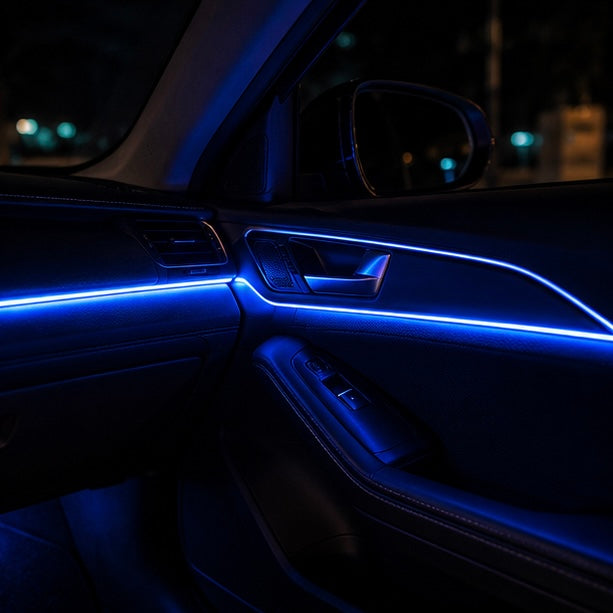
Fiber optic systems separate the light source from the light. A small LED module sits somewhere hidden — behind a trim panel, under the dash — and couples its output into the end of a transparent optical fiber. That fiber, typically a millimetre or two thick, carries the light along its length.
The visible glow comes from side emission: the fiber's surface is treated or structured so that light leaks out gradually along the whole run rather than only at the far end. Because the light is generated at one point and distributed by the fiber, there are no individual diodes to see — you get a continuous line rather than a series of points.
Two practical consequences follow. First, the fiber itself is thin and flexible, so it can be tucked into panel gaps, headliner seams and trim joints that a strip would not fit into. Second, brightness falls off gradually along the run, which is why fiber systems specify a length: run it much further than intended and the far end will be noticeably dimmer.
Fiber is commonly used for roofline runs, door trim seams, dashboard edges and anywhere the goal is a defined line of light rather than a broad wash.
Factory/OEM Ambient Lighting
Factory systems are designed into the car. The trim is moulded around the light guide, the wiring is part of the loom, and control is integrated into the infotainment system. That is why OEM installations look seamless — the interior was engineered around the lighting rather than the other way round.
Aftermarket systems work in the opposite direction: they retrofit light into an interior that was not designed for it. The upside is cost and freedom of choice. The trade-off is that the quality of the result depends heavily on installation care, and that the system is usually powered from an accessory socket rather than integrated into the vehicle's electronics.
Comparison
| LED strip | Fiber optic | Factory/OEM | |
|---|---|---|---|
| Light source visibility | Diodes can be visible without good diffusion | Source is hidden; only the fiber glows | Fully concealed by design |
| Light distribution | Can show hotspots between diodes | Continuous line, gradual fall-off over distance | Engineered to be even |
| Best at | Washing broad areas (footwells, under-dash) | Defined lines along trim, roofline, doors | Whatever the designer specified |
| Thickness | Thicker; needs a place to sit | Very thin; fits into panel gaps and seams | Built into the trim |
| Effects | Chasing/gradient possible with addressable strips | Colour and brightness across the whole run | Varies by manufacturer |
| Typical power | USB or 12V socket | USB or 12V socket | Vehicle electrical system |
| Cost | Lowest | Mid | Highest — often option-pack pricing |
| Install effort | Low to moderate | Moderate; routing takes patience | Factory-fitted or dealer retrofit |
RGB Ambient Lighting: What Does It Actually Mean?
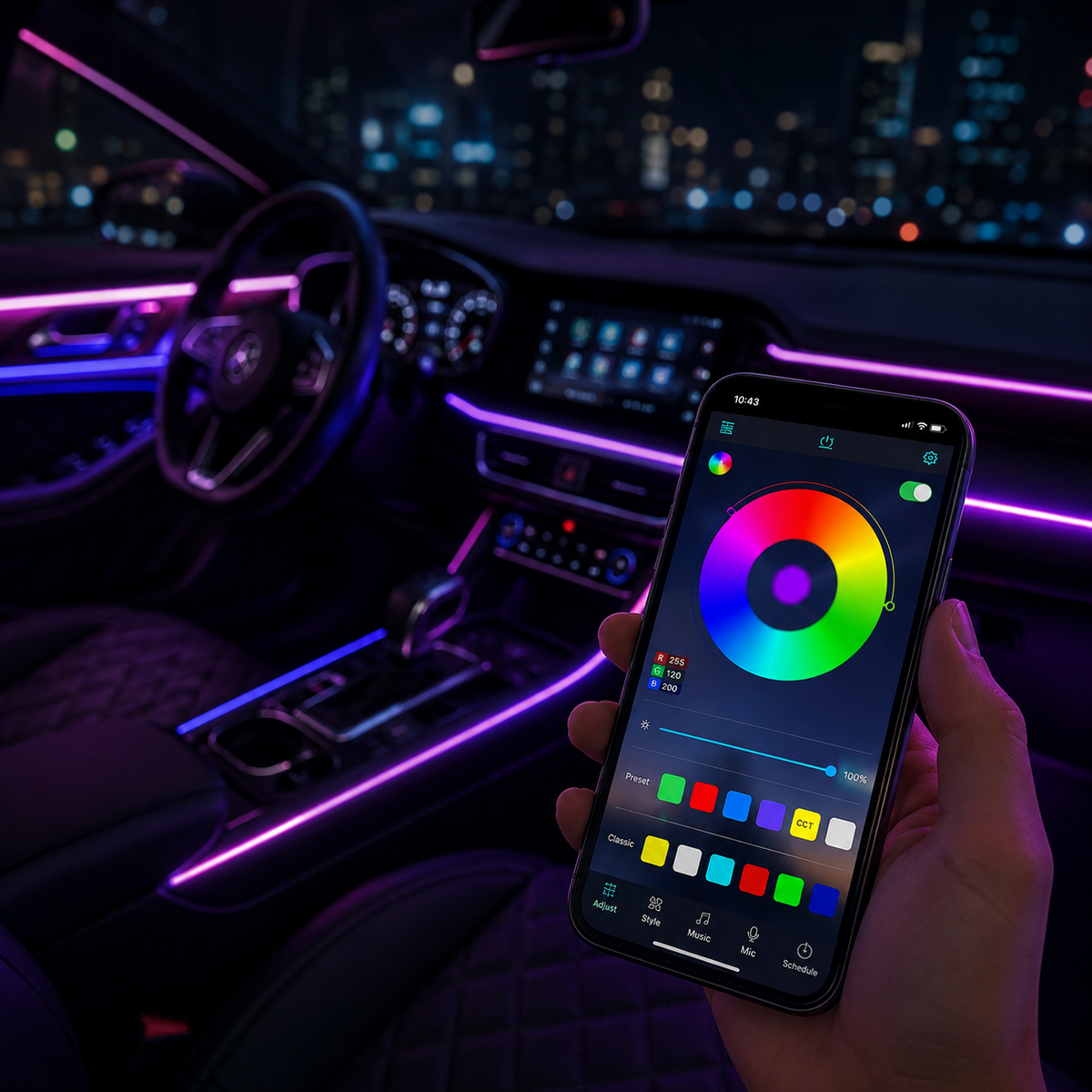
RGB means each light source contains three separate emitters — red, green and blue — whose individual intensities are mixed to produce a single output colour. Every colour the system can display is a recipe of those three.
The familiar "16 million colours" figure comes directly from that. Most RGB controllers use 8 bits per channel, giving 256 levels each of red, green and blue. Multiply them — 256 × 256 × 256 — and you get 16,777,216 possible combinations.
Two honest caveats are worth stating, because marketing rarely does.
First, that number describes the size of the colour palette, not how many colours appear at once. In a single-source fiber optic system, the whole run displays one colour at a time (or one colour sequence). "16 million colours" means you can choose from an enormous range — not that 16 million of them are visible simultaneously.
Second, the human eye cannot distinguish anything close to 16 million shades, and many adjacent values in an RGB space are visually identical. The practical benefit of a large colour space is fine control — being able to nudge a blue slightly warmer until it matches your instrument cluster — rather than raw variety.
Beyond static colour, most RGB controllers offer:
- Brightness control, which matters more than colour for a premium result. A system with too few brightness steps will be either too dim or distractingly bright with nothing usable in between.
- Dynamic effects — fading between colours, breathing, strobing, cycling through the spectrum. Used sparingly these are pleasant; used constantly they are the fastest way to make an interior look cheap.
- Music synchronisation, where a microphone in the controller picks up cabin audio and modulates brightness or colour with the beat. Note that this responds to ambient sound in the cabin, not to a digital audio feed, so its behaviour depends on volume and on how much road noise is present.
What Should You Look For When Buying Car Ambient Lighting?
This is the section that determines whether you are happy in six months.
1. Light quality. Look for even output along the whole run and consistent colour rendering. Judge from real installation photos or video shot at night, not from renders. Uneven brightness and colour shift along a run are the two most common failings.
2. Installation method. Understand before you buy whether the system is adhesive-mounted, tucked into panel gaps, or requires trim removal. This determines both the effort involved and how well hidden the result will be.
3. Fiber length or coverage. Measure the runs you actually want to light before ordering. A roofline perimeter, a two-door dashboard-and-doors run, and a full four-door interior are very different lengths. Buying short means an incomplete run; buying very long means excess to hide.
4. Power source. Check what the system needs and what your car has free. More on this below.
5. Control method. App, remote and physical control each have trade-offs. App control offers the finest adjustment; a physical control is faster and does not depend on your phone. Whatever the method, it should be adjustable without taking your attention off the road.
6. Music synchronisation. If you want it, check whether it is microphone-based and whether sensitivity is adjustable. Fixed-sensitivity sync tends to be either unresponsive at low volume or frantic at high volume.
7. Vehicle compatibility. Aftermarket ambient lighting is generally not vehicle-specific, but fit still depends on your interior. Consider the shape of your headliner, whether your trim has usable panel gaps, and where a controller can sit out of sight. If you are unsure, ask the seller before ordering.
8. Build quality. Housing material, connector quality and cable strain relief matter in a cabin that heats, cools and vibrates constantly. Cheap connectors are the most common failure point.
9. Heat and electrical considerations. Check the stated voltage and current draw and make sure it matches your power source. A system should never be spliced into airbag, sensor or safety-critical wiring, and cabling must never be routed anywhere it could interfere with pedals, steering, seat travel or airbag deployment zones. If a job requires cutting into the factory loom, have a qualified auto electrician do it.
10. Warranty and return policy. Ambient lighting is one of those upgrades where the result is partly subjective. A clear return window is worth real money.
USB vs. Cigarette Lighter Power
Most aftermarket systems draw power from one of two places, and neither is universally better.
USB-powered systems plug into any USB port in the cabin. They are convenient, the connector is compact, and USB ports are often located in places — centre console cubbies, under-dash trays — where the cable can disappear immediately. The considerations: your car needs a spare USB port that stays powered when the ignition is on, and if your only ports are in awkward spots the cable routing may be less tidy than it sounds.
Cigarette-lighter-powered systems plug into the 12V accessory socket. This is genuinely plug-and-play, it does not consume a USB port you might want for a phone, and 12V sockets are present in a very wide range of vehicles including older ones. The considerations: the adapter body is bulkier and more visible than a USB plug, and if you already use the socket for a dash cam or charger you will need a splitter.
The right answer depends on your specific car: which socket is free, where it sits relative to where you want the controller hidden, and which cable run you can conceal more cleanly. Work out where the controller will live first, then choose the power option that reaches it most discreetly.
Fiber Optic vs. LED Strip Ambient Lighting
| Fiber optic | LED strip | |
|---|---|---|
| Appearance | A fine, continuous line of light | A broader band or wash of light |
| Light distribution | Even along the run; dims gradually toward the far end | Bright and consistent, but can show hotspots without good diffusion |
| Light source visibility | Source is remote and hidden | Diodes may be visible depending on diffuser and viewing angle |
| Installation | Thin and flexible; tucks into seams and panel gaps, but routing takes patience | Faster to mount, but needs a flat-ish surface with clearance |
| Flexibility | Follows curves and tight radii easily | Limited on compound curves |
| Customisation | Colour and effects apply across the run | Addressable strips allow per-segment effects and chases |
| Overall aesthetic | Closer to the integrated OEM look | More visible, more overtly modified |
Neither is objectively better; they solve different problems. Fiber suits you if you want a defined line that follows the architecture of the interior and reads as though it might have come from the factory. Strips suit you if you want to illuminate an area — footwells, under-seat space, boot — or if segment-by-segment effects are the point.
Plenty of well-executed interiors use both: fiber along the visible trim lines, strips hidden in the footwells where nobody sees the source anyway.
Can You Install Ambient Lighting in Any Car?
Mostly, but not universally — and the honest answer is that it depends on your interior rather than on your badge.
Aftermarket ambient lighting is generally designed to be interior-agnostic rather than model-specific, which is why the same kit can work in a hatchback, an estate and an SUV. What actually determines fit is:
- Available installation space — somewhere to conceal the controller and any excess cable or fiber.
- Interior trim — usable panel gaps and seams for tucking fiber. Some interiors have generous, well-defined trim joints; some are moulded as near-continuous surfaces with very little to work with.
- Power access — a free USB port or 12V socket that is live with the ignition.
- Cable routing — a path from power to controller to light runs that avoids pedals, steering components, seat rails and airbag deployment areas.
- System dimensions — fiber length versus the length of the runs you want to light.
- Installation method — whether you are willing to remove trim panels, and whether your car's trim tolerates removal without damage.
Panoramic roofs, fabric versus hard-moulded headliners, and unusually shaped door cards are the usual complicating factors. If your interior is unusual, ask before you buy rather than after.
How Difficult Is It to Install Car Ambient Lighting?
Difficulty varies enormously, and anyone promising a fixed installation time for every vehicle is guessing.
The easiest case is a plug-in system in a car with a conveniently placed socket and generous trim gaps. Plug in the power, tuck the fiber or strip into the seams, hide the controller, done.
It gets harder when the interior requires trim removal, when cables have to cross from one side of the cabin to the other, or when the runs pass over pillars and around door apertures. The parts that consume time are:
Trim routing. Fiber and strips both need to sit in a gap that holds them without being visible. Finding that gap, and seating the material consistently along the whole run, is the slowest step and the one that determines the final look. A plastic scraper or trim tool is essentially mandatory — metal tools scratch and mark.
Hiding cables. Every visible centimetre of cable undermines the effect. Plan the full route before you commit anything to adhesive.
Positioning the light source. In a fiber system, the module needs to be hidden but reachable, with the fiber leaving it at a gentle angle. Sharp bends near the module cost you brightness.
Connecting power. Use the connection the manufacturer specifies. Do not splice into unfamiliar circuits, do not tap airbag or sensor wiring, and if you want a hardwired installation instead of a socket, have an auto electrician do it.
Follow the instructions supplied with your specific kit. Where you have a choice between rushing and stopping to plan the next section properly, stop and plan — the difference shows for as long as you own the car.
How to Make Aftermarket Ambient Lighting Look Premium
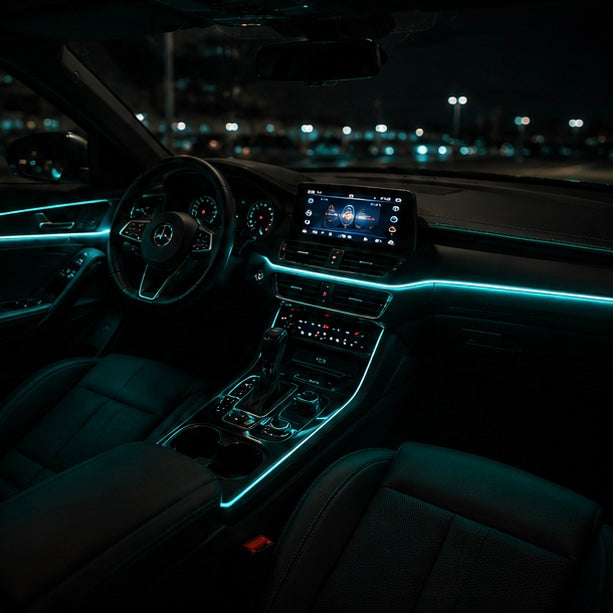
The gap between a factory-looking installation and an obviously aftermarket one comes down to a handful of decisions, none of which cost extra.
Route cables invisibly. No cable should be visible from any normal seating position. Run everything behind trim, along existing looms, under carpet edges. This is the single biggest tell.
Keep the light distribution consistent. A run that is bright at one end and dim at the other looks like a mistake. Respect the stated fiber length and avoid tight bends that choke the light.
Go dimmer than you think. Almost every unconvincing installation is too bright. Ambient lighting should be at the edge of your vision, not competing with the instrument cluster. If it lights up faces, it is too bright.
Choose colours deliberately. Pick a colour that relates to something already in the cabin — the instrument cluster, the infotainment accent, the stitching. A single well-chosen tone looks considered; constant colour cycling looks like a demo mode.
Hide the source. You should see the glow, never the emitter. Angle light sources away from the eyeline and behind trim edges.
Do less. One clean line along the roofline and doors beats five lines everywhere. Restraint is the whole aesthetic — factory systems light a small number of carefully chosen edges, not every surface.
Match the material. Light behaves differently on leather, Alcantara, gloss black and textured plastic. Gloss surfaces reflect the source and can create a visible double line; matte surfaces absorb and soften. Test the position by hand before fixing anything permanently.
Is Car Ambient Lighting Worth It?
It depends on how you use your car, and it is worth being honest about that.
It is likely worth it if:
- You drive at night regularly. Commuters, night-shift workers and people who do long evening motorway runs get the benefit almost every time they get in.
- You enjoy interior customisation and treat the cabin as a space rather than a place you pass through.
- Your interior is dark, plain, or plastic-heavy. Ambient lighting adds visual interest to interiors that have none, which is why it transforms budget and older cabins more dramatically than premium ones.
- You want the modern-interior feel without changing cars.
It is probably not worth it if:
- You drive almost exclusively in daylight. The effect is close to invisible in sunlight.
- You are sensitive to light while driving, or find any in-cabin illumination distracting.
- You are unwilling to spend time on installation and unwilling to pay someone else. A rushed install of a good system looks worse than no install at all.
- You are hoping it will improve visibility or practical function. It will not — this is an aesthetic upgrade.
There is also a legal dimension worth checking rather than assuming. Rules on interior lighting colours visible from outside the vehicle — particularly red and blue — vary between countries and sometimes between regions. Check your local regulations before choosing colours that are visible externally.
VELVOREX SkyGlow™
If, having read the above, a fiber optic roofline system is the direction that appeals to you, VELVOREX SkyGlow™ is our take on it — panoramic ambient roof lighting built around a fiber optic light run.
What it does. SkyGlow is an RGB system offering 16 million colour options, with music sync that responds to audio input in the cabin, and high-quality optical fiber chosen for even and consistent light distribution along the run. It is designed to work with a range of car models and interior layouts — not every vehicle, since headliners differ, so check with us first if your interior is unusual.
Installation. SkyGlow uses an embedded setup and ships with a scraper tool and an instruction manual for mounting. As with any fiber system, the routing is the part that decides how clean the result looks, so give it an unhurried evening.
Technical specifications
| Material | ABS |
| Power | 5W |
| Voltage | 12V |
| Current | 0.3A |
| Optical fiber length | 5 m or 6 m depending on variant |
| Package dimensions | 25.3 cm × 15.1 cm × 4 cm |
| Weight | 400 g per set |
The two variants
SkyGlow comes in two configurations. They are the same product; what differs is how it draws power and how much fiber you get.
| USB Cable · 6 m Fiber | Cigarette Lighter · 5 m Fiber | |
|---|---|---|
| Power connection | Any USB port in the cabin | 12V accessory socket |
| Optical fiber | 6 m | 5 m |
| Light heads | 5 | 4 |
| Suits | Cars with a spare, conveniently placed USB port; longer runs | Cars with no free USB port, or where the 12V socket is better placed |
Choose based on which socket in your car is free and better positioned relative to where the controller will be hidden.
What's included
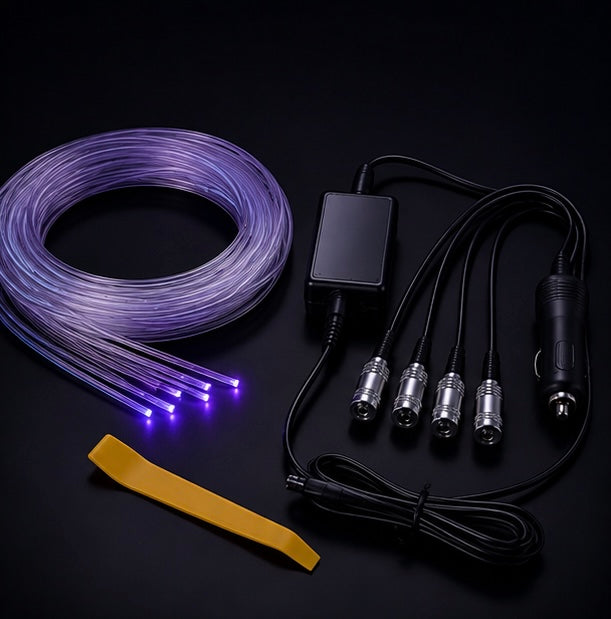
- LED atmosphere light controller ×1
- Optical fiber cable ×1 (5 m or 6 m depending on the selected variant)
- Power cable ×1
- Scraper tool ×1
- Instruction manual ×1
If you are lighting the roofline, the logical next step is the floor — our illuminated floor mats carry the same fiber optic approach into the footwells so the cabin reads as one piece. And for anyone whose interest in lighting does not stop at the windscreen, Demon Eyes applies a similar idea to the projector housings up front.
Frequently Asked Questions
What is car ambient lighting?
Car ambient lighting is low-level decorative interior illumination designed to create atmosphere rather than to help you see. It is typically installed along trim, doors, dashboards, footwells or the roofline, and runs continuously while driving.
Is aftermarket ambient lighting worth it?
It is worth it if you drive at night regularly, enjoy interior customisation, or have a plain interior that would benefit visually. It offers little value if you drive mainly in daylight, find in-cabin light distracting, or are expecting a functional rather than aesthetic improvement.
What is RGB ambient lighting?
RGB ambient lighting uses light sources containing separate red, green and blue emitters that mix to produce a chosen colour. The common "16 million colours" figure comes from 256 brightness levels per channel — 256 × 256 × 256 = 16,777,216 possible combinations. That is the size of the palette, not the number of colours shown at once.
Is fiber optic lighting better than LED strips?
Neither is universally better. Fiber optic produces a fine, continuous line with the light source hidden, which looks closer to factory-integrated lighting. LED strips are brighter over broad areas and support per-segment effects with addressable versions. Fiber suits trim lines; strips suit footwells and areas.
Can ambient lighting be installed in any car?
It can be installed in a wide range of vehicles, but not universally. Fit depends on available installation space, interior trim and panel gaps, access to a power source, viable cable routing, and whether the system's dimensions suit the runs you want to light.
How is car ambient lighting powered?
Aftermarket systems usually draw power from a USB port or the 12V accessory socket. USB is compact and convenient if you have a spare port; the 12V socket is plug-and-play and available in a wider range of vehicles, but the adapter is more visible. Factory systems are wired into the vehicle's electrical system.
Can car ambient lighting sync with music?
Many RGB systems include music synchronisation, typically using a microphone in the controller that picks up cabin audio and modulates brightness or colour with the beat. Because it responds to ambient sound rather than a digital audio feed, its behaviour varies with volume and road noise.
How difficult is ambient lighting to install?
Difficulty varies by vehicle. A plug-in system in a car with an accessible socket and generous trim gaps can be straightforward; installations requiring trim removal or cable runs across the cabin take considerably longer. Routing and concealing the light-carrying element is the slowest and most important step. Always follow the instructions supplied with your kit, and use a qualified auto electrician for any hardwired connection.
0 comments